Customized Traccar Server
Custom GPS fleet management with BCE protocol parsing
What is Customized Traccar Server?
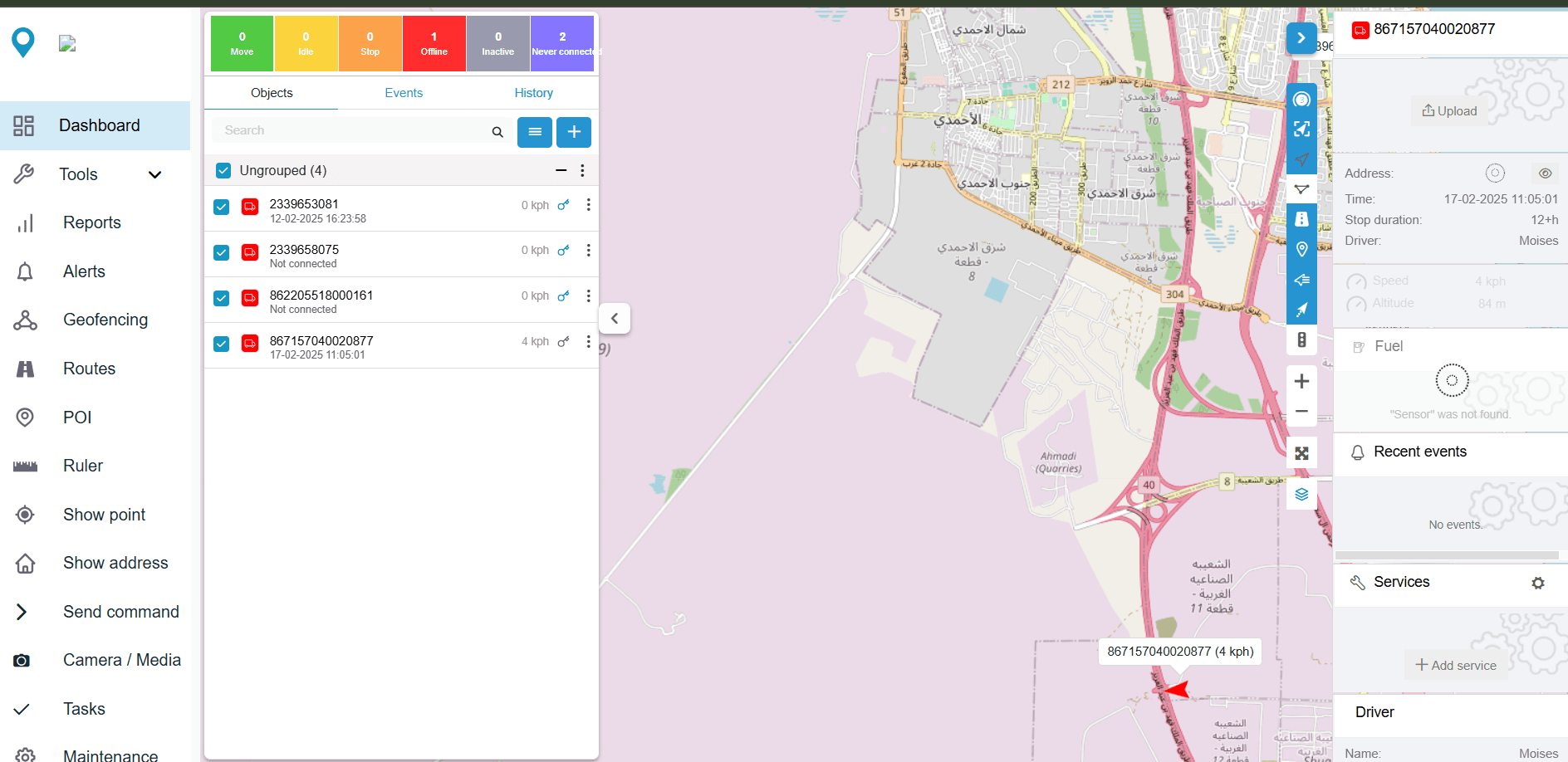
A heavily customized deployment of the Traccar open-source GPS tracking server for a Gulf-region fleet operator running 200+ vehicles, extended with a custom BCE device protocol decoder and integrated with the operator's ERP/operations system for real-time reporting.
Why wasn’t stock Traccar enough for 200+ vehicles?
The operator's 200+ vehicles ran BCE-protocol GPS devices that Traccar didn't support out of the box. Position data arrived with broken timestamps — surfacing as out-of-order and duplicated positions in the downstream ERP/operations system — and live tracking data needed to flow into that system continuously.
How Customized Traccar Server works
Forked the Traccar server, implemented a full BCE protocol decoder in Java, fixed server-side timestamp normalization, and built a bidirectional integration layer to push live tracking data to the external fleet system. All fleet devices now report in real time with accurate timestamps. The integration layer delivers live position updates to the fleet management dashboard with no manual data transfer.
Case Study in Depth
Who was the client, and what was broken?
A Gulf-region fleet operator running more than 200 vehicles — real scale, and the kind where tracking problems stop being an IT annoyance and start costing operational money daily. Their GPS hardware spoke the BCE protocol, which Traccar didn't support out of the box, and the stopgap parsing they had was mangling timestamps: positions arrived into their ERP/operations system out of order and duplicated, which quietly corrupts everything downstream — trip reconstructions, utilization reports, anything that assumes a vehicle's history is a clean ordered sequence.
The brief had three parts that had to land together: make Traccar speak BCE properly, make every position carry a timestamp the downstream systems could trust, and make the data flow into the operator's ERP/operations platform in real time instead of by export. Any two out of three would still have left the fleet blind somewhere.
Why build on Traccar instead of replacing it?
Because the alternative is rewriting a decade of solved problems. Traccar is the leading open-source GPS tracking server: device communication, position storage, geofencing, and a management UI already exist and are maintained by an active project. Its Java codebase is explicitly designed for extension — a new protocol decoder is a well-defined component with clear boundaries, not surgery on a black box. For an operator with 200+ vehicles of already-purchased hardware, the economics are decisive: the cost of a decoder plus integration work is a fraction of either replacing the device fleet or licensing a proprietary platform per-vehicle per-month, and at the end the operator owns the server, the data, and the roadmap.
How do you write a protocol decoder for Traccar?
The BCE decoder was implemented in Java from the protocol documentation — the disciplined path: read the spec, implement the message framing, then map each message class the devices emit (positions, status, alarms) onto Traccar's internal position model. The craft is in the edge cases the spec understates: partial frames arriving across TCP segment boundaries, fields whose units or byte order the documentation leaves ambiguous, and messages real devices send that the paper protocol never quite promised. Every mapping decision was validated against live traffic from the actual fleet before it was trusted.
Done properly, the decoder makes unsupported hardware indistinguishable from natively-supported hardware: the devices connect, Traccar decodes, and every downstream feature — history, geofences, the integration layer — works without knowing anything unusual happened. That's the standard this work was held to, across a 200-vehicle production rollout where a decoding bug would surface as fleet-wide bad data by morning.
What caused the timestamp chaos — and how was it fixed?
GPS trackers report two times: the moment the device recorded a position, and the moment the server received it. Under intermittent connectivity — which is every real fleet — devices buffer positions and send them in bursts, so the two times can differ by minutes or hours. The broken parsing conflated them, so a burst of buffered positions landed in the database stamped with arrival time: instantly out of order relative to reality, and duplicated where retries overlapped. The operator's ERP saw vehicles teleporting and trips that reconstructed nonsensically.
The fix was server-side timestamp normalization at the ingestion boundary: trust the device's recorded time, validate it against sane bounds, deduplicate on the device's own sequence identity rather than arrival order, and only then let a position into the pipeline. Unglamorous work with an absolute payoff — every report, geofence event, and audit trail downstream inherits its correctness from this one boundary.
How does the bidirectional integration work?
Outbound, the integration layer pushes every validated live position from Traccar into the operator's ERP/operations system as it arrives — no exports, no batch jobs, no manual transfer. Inbound, the same layer lets the operational side talk back, so fleet configuration flows in the other direction and the two systems behave as one product rather than two databases with a courier between them. For the operator's staff, Traccar disappeared into the infrastructure: they work in the system they already know, and the tracking data is simply there, current, and correctly ordered.
The transferable result
Unsupported hardware, untrustworthy timestamps, and a disconnected downstream system are the three standard ways a fleet-tracking deployment fails. This engagement fixed all three inside the operator's existing investment — no device replacement, no per-vehicle subscription, full ownership of server and data.
Client feedback on this project
RP€80 EURRigas P.
Freelancer.com · 6 years ago
“Worked well with Zameer to do a feasibility study for an integration of our system. Good communication and proactiveness.”
Related Projects
Like what you see? Let's build something together.
Send Project Brief →