Services
Custom Fleet Tracking Software Development
I build and customize GPS fleet-tracking and logistics platforms, with deep specialist work on the open-source Traccar server. Custom fleet tracking software development is a narrower craft than general web work: it means device protocols, position streams, timestamp discipline, and integrations into the systems where fleet decisions actually get made. For one fleet client I forked Traccar, implemented a full BCE device-protocol decoder in Java, fixed server-side timestamp normalization, and built a bidirectional integration layer pushing live position data into their external fleet-management system — so every device reports in real time with accurate timestamps. If your fleet runs non-standard tracking hardware, or your tracking data needs to flow somewhere off-the-shelf tools won't send it, that is exactly the work I do.
Ideal for: Logistics companies, delivery fleets, real-time vehicle tracking
Pricing
Fixed-bid quote within 48 hours of your brief — no hourly-billing surprises
Availability
Response within 24 hours; new projects typically start within 1–2 weeks
Engagement
Fixed-bid project, ongoing retainer, white-label for agencies, or team augmentation
Track record
Top Rated Plus on Upwork · 4.9★ across 43 reviews on Freelancer · Top 3% globally
When does custom fleet tracking software make sense?
Honest answer first: many fleets don't need custom software. If you run standard trackers and need live positions, trip history, and basic alerts, a subscription GPS platform will serve you well for less than custom development costs. Custom fleet tracking software earns its keep in three situations:
- Unsupported hardware — Your trackers speak a protocol the off-the-shelf platforms don't support.
- Deep integration — Your tracking data has to feed systems that matter more than the map — dispatch, billing, maintenance, a customer portal.
- Subscription economics — Per-vehicle-per-month pricing compounds brutally as a fleet grows, while a self-hosted platform's costs stay nearly flat.
There's a fourth reason that surfaces later: ownership. On a rented platform your position history, driver behavior data, and integration logic live inside someone else's product, exportable only as far as their API allows. A fleet that treats tracking data as an operational asset — for customer ETAs, insurance evidence, route optimization — eventually wants that data in its own database under its own roof. That's the point where companies come looking for custom development, usually with two years of data they wish they owned.
The pragmatic middle path, and the one most of my fleet work takes, is not building from zero: it's building on Traccar, the open-source GPS tracking server. You get a mature core — device communication, position storage, a management UI — for free, and spend the custom-development budget only on what makes your operation different.
What can be built on the open-source Traccar server?
Traccar supports a very large catalogue of tracker protocols out of the box, and for unsupported hardware its Java codebase is built to be extended — a new protocol decoder is a well-defined component, not open-heart surgery. That's precisely the work in my fleet case study: a full BCE protocol decoder implemented in Java, so a fleet's existing non-standard devices reported into Traccar like first-class citizens instead of forcing a hardware replacement across every vehicle.
Beyond protocol support, the highest-value Traccar work is usually at its edges. Inbound: normalizing what devices report — my fleet client's position records carried wrong timestamps until I fixed normalization server-side, which matters because every downstream report, geofence event, and audit trail inherits that timestamp. Outbound: Traccar's forwarding and REST API let live positions flow into external systems, and I build bidirectional integration layers on exactly that path — positions streaming out to a fleet-management system, commands and configuration flowing back. The result behaves like one product, with Traccar as an invisible engine room.
Can tracking data feed our existing business systems?
Yes — and for most operations this is the tier where custom fleet work pays for itself fastest, because the map is rarely where fleet decisions get made. Dispatch boards, billing engines, maintenance schedulers, ERPs, and customer portals all run better on live position data, and Traccar exposes three supported surfaces for getting it to them:
position storage
The reference build is the bidirectional ERP integration in my fleet case study: every validated position streams from the forked Traccar server into the operator's ERP in real time, and device management flows back the other way, so the operator's staff never left the system they already knew. No exports, no manual transfer, no second interface to train on.
If your tracking data currently reaches your business systems by spreadsheet — or not at all — that gap is a well-bounded project, not a rebuild, and my Traccar API integration guide walks the technical shape of it.
What have I shipped for production fleets?
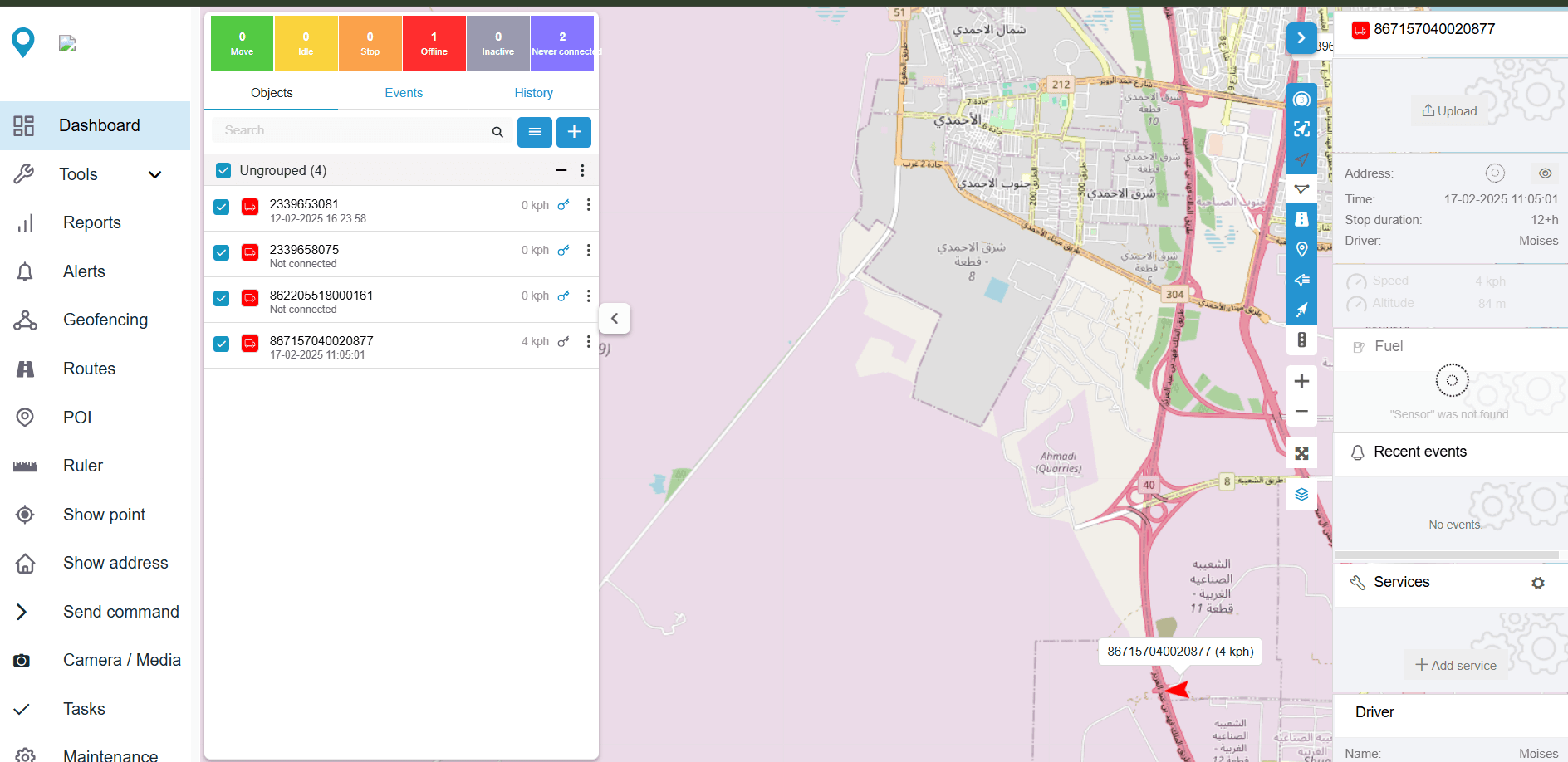
The centerpiece is the Traccar fleet server engagement: a forked Traccar deployment carrying a custom BCE protocol decoder, corrected timestamp normalization, and a bidirectional integration layer feeding live position data into the client's external fleet-management system in real time. Every vehicle reports with accurate device time; every position lands in the system where dispatch actually works.
The same real-time discipline runs through AetherMesh, my enterprise asset-tracking platform — hundreds of physical assets across multiple sites, telemetry to dashboard in under a second, multi-tenant from day one. Fleet tracking and asset tracking are siblings: the same ingestion, storage, and live-map problems, pointed at vehicles in one case and equipment in the other. If your logistics operation needs both, they can share one backend.
What should a small fleet use for GPS tracking?
For a small fleet — a handful to a few dozen vehicles — the honest starting advice is: use a subscription platform first if your needs are standard, and graduate to your own platform when they stop being standard. The graduation triggers are concrete: monthly per-vehicle fees crossing what self-hosting would cost; trackers you want to use that the platform won't support; or an integration you need (customer-facing ETAs, automated billing from trip data, maintenance scheduling from mileage) that the platform's API can't deliver.
When a small fleet does graduate, a self-hosted Traccar deployment customized to the operation is usually the right-sized answer — not a ground-up build. The core platform is open source, so the budget goes to configuration, any protocol work your hardware needs, and the one or two integrations that motivated the move. You own the server, the data, and the roadmap, and adding vehicle twenty-one costs you nothing per month.
Is custom the right call for your fleet at all?
Sometimes it isn't, and saying so early is cheaper for both of us. If your hardware needs are standard, ELD compliance or camera-based safety programs are central to your operation, and the subscription line fits at your fleet's size, an established platform like Samsara or Geotab is a defensible buy — those bundles are genuinely hard to replicate, and replicating certified compliance tooling is not a good use of a custom budget. The custom case turns on four things: hardware the platforms don't support, integrations deeper than their APIs reach, ownership of your data and cost curve, and per-vehicle economics that stop working as the fleet grows. I've written the full decision guide — including Traccar vs Samsara and Traccar vs Geotab head-to-heads — as a standalone comparison, linked below, so you can pressure-test the choice before ever sending a brief.
What does custom fleet software cost?
Fleet quotes here are fixed-bid, delivered within 48 hours of your brief. The cost drivers are predictable: whether your hardware needs new protocol decoders (the largest single variable — supported devices integrate cheaply, undocumented ones need decoding work); how many external systems the tracking data must flow into and whether those flows are one-way or bidirectional; the depth of the operational layer beyond the map — alerting, geofencing, driver reports, customer-facing views; and hosting posture, from a single self-hosted server to a multi-tenant platform.
Because the Traccar core is open source, a customized deployment usually lands far below a from-scratch build — you're paying for the delta between what Traccar does and what your operation needs, not for reinventing position ingestion. The fixed bid makes that delta a number you can compare directly against your current subscription line item.
What should you look for when hiring a fleet tracking developer?
Fleet tracking is a specialty inside backend engineering, and generic web-development experience doesn't transfer as directly as portfolios imply. Four things separate developers who have shipped fleet systems from those who haven't:
- 1.Protocol literacy — Can they read a tracker's protocol documentation — or raw device output — and tell you whether your hardware needs configuration, decoder adaptation, or a new decoder?
- 2.Timestamp discipline — Ask how they handle devices that buffer offline and flush late. Anyone who hasn't been burned by device-time-versus-arrival-time will learn it on your fleet.
- 3.An integration record — Fleet data almost always has somewhere else to be, so evidence of production integrations into ERPs or dispatch systems matters more than map demos.
- 4.Scoping honesty — A developer who can't tell you what you don't need is selling, not scoping.
Those are the standards I invite clients to hold me to. My answers are on this site in the open: a 200+ vehicle production deployment with a from-documentation BCE protocol decoder, a timestamp-normalization fix that repaired a corrupted downstream ERP feed, a bidirectional integration layer, and published technical guides deep enough that you can judge the thinking before we ever speak. Send a sample of your device output with your brief and you'll get the same triage — configuration, adaptation, or decoder — inside the same 48 hours as the quote.
What keeps a tracking platform healthy after launch?
Fleet platforms live in a changing world: tracker firmware updates alter what devices report, hardware gets added from new suppliers, the systems downstream of the integration evolve, and position volume grows with the fleet. The launch-day build handles the world as it was scoped; staying healthy is an ongoing property. The practical checklist is short — watch for devices that go quiet or start reporting anomalies, re-verify decoder behavior when firmware changes, keep the Traccar core current so protocol and security fixes keep arriving, and monitor the integration path end-to-end rather than assuming silence means success.
Structurally, the customization approach on this page is what makes that maintenance cheap: because decoders are contained extensions and integrations ride on supported API surfaces, upgrading the core stays routine instead of becoming an archaeology project. Most clients cover this with a light retainer; the handover documentation is written so that any Java-capable developer could do it instead. Either way, the platform you own keeps pace with the fleet it tracks.
How do we work together?
Four engagement models, depending on what you need:
- Fixed-bid project — A scoped build with a quoted price — the default.
- Ongoing retainer — Keeping a live tracking platform healthy as devices, firmware, and requirements change.
- White-label — Delivery under your agency's brand for firms serving logistics clients — NDA-friendly, with anonymized case studies as standard practice.
- Team augmentation — A senior backend or protocol specialist embedded in your team for a defined push.
Remote-first and worldwide, response within 24 hours, new engagements typically starting within one to two weeks.
Case Studies
What production work backs this up?
FAQ
What do clients ask before hiring?
Can Traccar support our tracker devices?
Very likely — Traccar ships with support for a very large catalogue of GPS tracker protocols, so the first step is simply checking your device model against it. If your hardware is supported, integration is configuration work. If it isn't — a proprietary protocol, a regional brand, or a device that almost-but-not-quite matches an existing decoder — that's the specialist case I handle: I've implemented a complete BCE protocol decoder in Java inside a forked Traccar server for exactly this situation. The decision input I'd need from you is a sample of the device's raw output or its protocol documentation; from that I can tell you in days, not weeks, whether it's configuration, adaptation, or a new decoder.
Do we own the platform and the data?
Yes — that's most of the point of going custom. A self-hosted Traccar deployment runs on your server or cloud account, its database is yours, and the customization work I deliver (decoders, integrations, UI changes) is handed over as source code with documentation. There is no per-vehicle subscription and no vendor holding your position history. Traccar itself is open source under active development, so you're standing on a maintained foundation rather than a bespoke black box — and any developer who knows Java can pick up where I leave off, though most clients keep a retainer for exactly that continuity.
Can live positions flow into our ERP or dispatch system?
Yes — in real time, and in both directions if needed. Traccar's supported integration surfaces (REST API, WebSocket stream, and server-side position/event forwarding) let every validated position push into an external system the moment it's processed, with no polling and no exports. That is exactly the architecture of my reference deployment: a 200+ vehicle fleet whose positions stream continuously into the operator's ERP, while device management flows back the other way, so their staff work entirely inside the system they already knew. The scoping questions that size such a project are how many target systems there are and whether each flow is one-way or bidirectional.
Do you only work with large fleets, or with fleets in a specific region?
Neither. The reference deployment happens to be a 200+ vehicle Gulf-region operator, but the work is remote-first and worldwide, and the same architecture scales down cleanly — a self-hosted Traccar deployment is often most compelling for small and mid-sized fleets, where per-vehicle subscription pricing is hardest to justify. Smaller fleets usually need a subset of the same tiers: configuration, perhaps one protocol adaptation, and the one or two integrations that motivated going custom. The 48-hour fixed-bid quote works identically at any size; the number simply reflects the delta between stock Traccar and what your operation needs.
Can you customize or integrate GPS fleet-tracking software?
Yes. I've forked and heavily customized the open-source Traccar GPS server — building a custom BCE device-protocol decoder, fixing server-side timestamp bugs, and integrating live tracking data into an external fleet management system. If your fleet uses non-standard tracking hardware or protocols, this is exactly the kind of integration work I do.
Can you integrate with our existing systems or third-party APIs?
Yes — API integration, legacy system extension, and database migration are common in most projects I take on. I've connected systems using REST, SOAP, MQTT, and various third-party platforms. If you have existing infrastructure, I'll assess it during discovery and design the integration approach carefully.
More answers on the full FAQ →
Have a fleet & logistics project in mind? Tell me about it.
Send Project Brief →